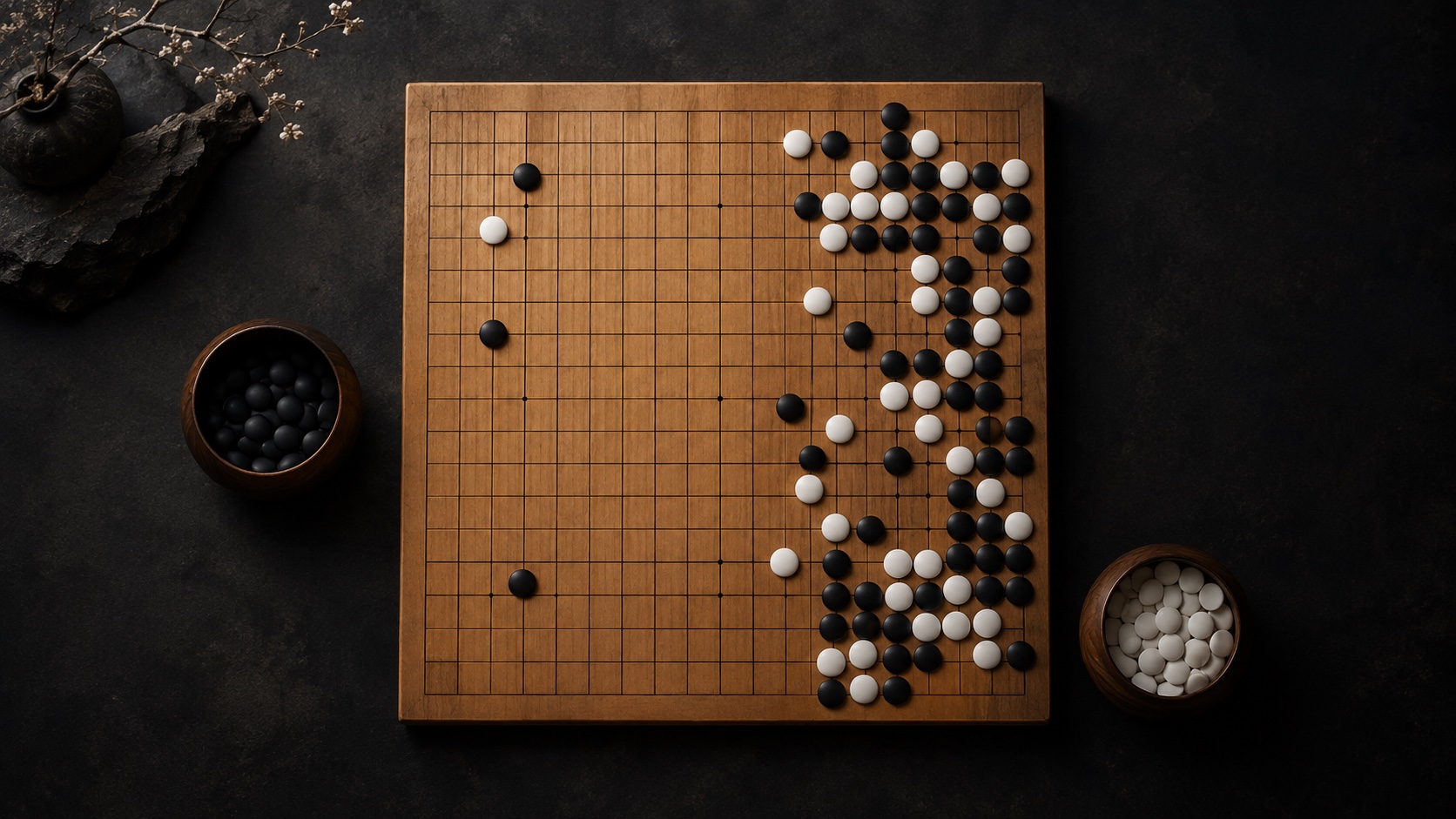
The essentials
- Black moves first; players then place one stone at a time.
- Stones stay where they are unless they are completely surrounded and captured.
- You win by controlling more territory than your opponent.
- Two consecutive passes end play and begin scoring.
The goal in one sentence
Use your stones to surround more empty space than your opponent. Captured stones also matter under common scoring systems, but the central idea stays the same: divide the board efficiently and secure your share.
You do not need to conquer everything. Most good games end with several black and white territories living peacefully beside one another.
Go is not a game of total destruction. Captures are a tool; efficient control of space is the goal.
What happens on a turn
Black starts by placing a stone on an empty intersection. White answers, and turns alternate. A stone never moves after it is placed. A move may capture, secure territory, protect a weak group, or open a new part of the board.
- Place on an empty intersection
- Remove opposing stones with no liberties
- Give the turn to the other player
Liberties keep stones alive
Every empty intersection directly above, below, left, or right of a stone is a liberty. Diagonals do not count. Connected stones of one colour form a group and share their liberties.
A group with no liberties is removed. This makes isolated stones fragile and well-connected groups much harder to attack.
When does the game end?
Two consecutive passes mean both players believe no worthwhile move remains. Clearly dead groups are removed and the board is scored.
For your first games, keep playing while you can still secure territory, reduce opposing territory, save a weak group, or complete an unsettled boundary.
Losing stones does not mean the game is over. A local loss is only one part of the whole board.